




How to Fix a Refrigerant Leak in Your AC: Professional Repair and Cost Guide
Refrigerant leaks let the cooling fluid in your air conditioner — commonly R‑410A, R‑32 or older R‑22 — escape the system. When that happens your AC loses cooling power, runs longer, and can cause damage to components while releasing substances that affect the environment. This guide walks you through why leaks matter for safety and efficiency, how to spot the most common signs, which professional detection methods technicians use, typical causes, and how to decide between repair or replacement. We also outline expected repair costs in Plant City, FL, and show how to request local service. Throughout, we use straightforward, industry-standard terms like evaporator coil leak, condenser coil leak, refrigerant recharge and electronic leak detector so you can understand what the technician is doing and when to call in a certified pro.
We’re Creamer Air Conditioning and Heating — a local, family‑owned HVAC company serving greater Tampa Bay from our Plant City, FL shop. Our technicians are certified, bonded and insured. Call our Plant City office at (813) 986-1881 or stop by 3304 Cooper Rd, Plant City, FL 33565 to request an estimate or schedule a diagnostic. If you suspect a leak, our local team can connect the troubleshooting below with a professional on-site inspection.
What Are the Common Signs of an AC Refrigerant Leak?
Low refrigerant shows up as reduced cooling and measurable system symptoms caused by poor refrigerant circulation and weakened heat transfer. You’ll often notice warmer supply air, longer run times, or higher indoor humidity. Catching a leak early limits compressor damage, cuts wasted energy and prevents unnecessary refrigerant release. Below are the most reliable signs to watch for and simple checks you can do before calling a technician.
Common signs to watch for include these observable and measurable symptoms:
- Warm air from vents: The system runs but the air coming from vents is noticeably warmer than the thermostat setting — a classic sign of low refrigerant.
- Ice on evaporator coil or lines: Frost or ice on the evaporator coil or suction line usually means the refrigerant charge is low and the coil is too cold.
- Hissing or bubbling noises: A steady hiss or bubbling sound near piping or fittings often points to refrigerant escaping under pressure.
- Visible oil stains: Refrigerant carries compressor oil. Oily spots around tubing, fittings or coils are a good indicator of seepage.
- Increased energy bills: A leaking system runs longer to reach set temperatures, so your electricity use and bills rise.
- Frequent short‑cycling: Rapid on/off cycles can result from abnormal pressures that leaks create.
These clues are useful diagnostics. Before assuming a leak, try the basics: replace a dirty air filter, make sure vents are open, and confirm thermostat settings. If the problem continues after those quick checks, schedule a professional diagnostic to confirm low refrigerant and locate the leak.
How Does Warm Air or Reduced Cooling Indicate a Leak?
Warm supply air usually means the evaporator isn’t absorbing heat the way it should. With less refrigerant in the loop, heat transfer drops and cooling capacity falls. A simple homeowner check is to compare your thermostat setpoint with the measured temperature at a supply vent — a much smaller-than-expected drop in temperature suggests low refrigerant. Remember other issues like clogged filters or a failing blower can produce similar symptoms, so rule those out first. If basic checks don’t help, a documented reduced delta‑T (temperature difference across the evaporator) and longer run times are strong reasons to bring in a technician for leak detection.
Don’t attempt invasive repairs yourself if warm airflow persists: handling refrigerants and opening the system require EPA‑compliant recovery equipment and certified technicians to stay safe and legal. Schedule a diagnostic and have vent temperatures and any visual signs ready to share — it speeds the technician’s work.
What Visual and Audible Symptoms Should You Watch For?
Visual and audible cues often point to where a leak is happening. Listen for hissing near exposed fittings or line sets, look for oily residue around joints, and watch for white frost on the evaporator coil or suction line. Those patterns suggest specific failure types — loose fittings, pinholes, or corroded coils. Don’t touch frozen lines or try to braze a repair yourself; pressurized refrigerant and sharp fins can cause injury. Photograph oil stains and note noise locations to help the technician diagnose faster.
If you find oil or hear persistent hissing, avoid running the system continuously and call a certified technician. Running an undercharged system risks compressor damage and wastes refrigerant. These visible and audible signs usually lead the tech to targeted detection methods covered below.
How Do Professionals Detect AC Refrigerant Leaks Effectively?
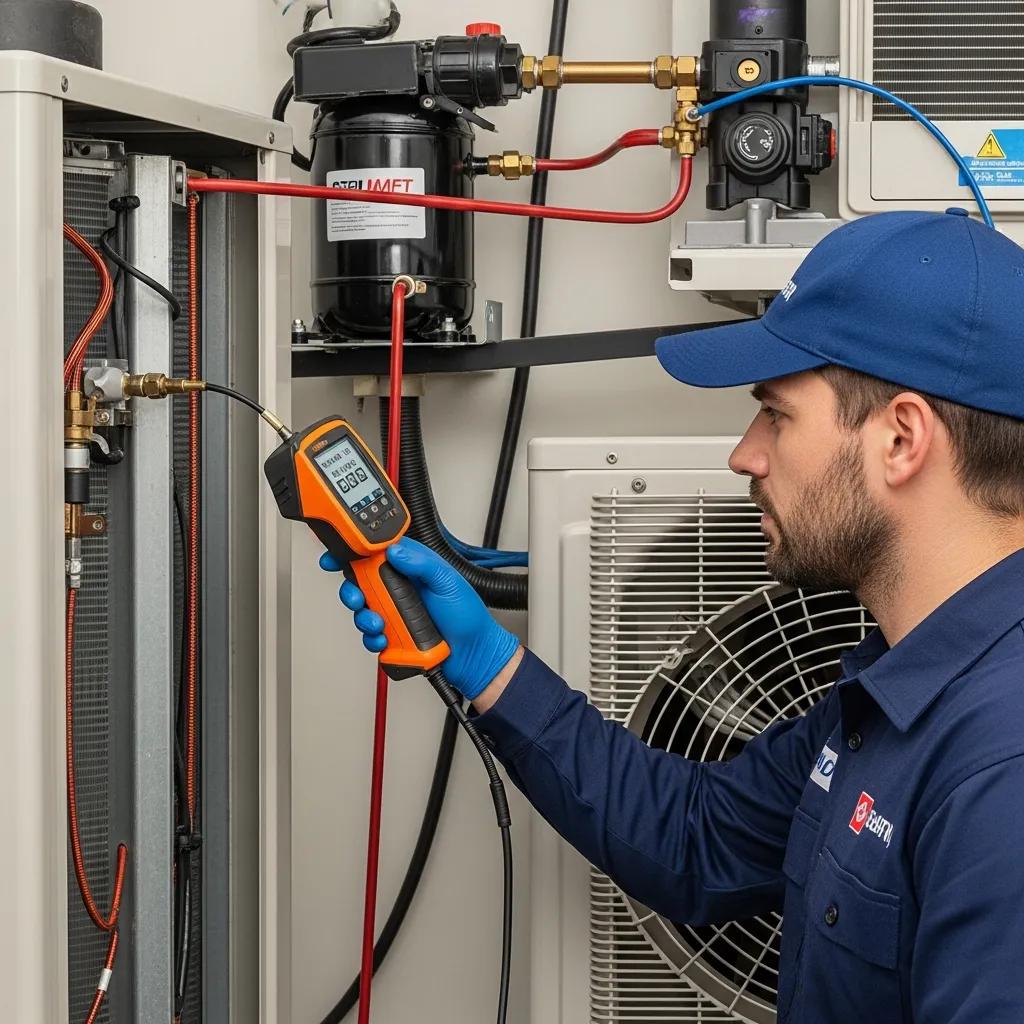
Technicians use sensitive instruments and pressure testing to find leaks while avoiding unnecessary part swaps. The usual workflow starts with a visual inspection and system pressure check, then moves to electronic sniffers, UV dye, soap‑bubble checks for accessible joints, and nitrogen pressure testing for stubborn or hidden leaks. The aim is to pinpoint the failed component — evaporator coil, condenser coil, line set or Schrader valve — so the repair is targeted and cost‑effective. Below is a concise look at standard detection methods.
Detection techniques continue to improve, especially for modern systems with electronic expansion valves and fewer sensors.
Residential AC Refrigerant Leak Detection Methods
A method for detecting refrigerant leakage in residential systems with electronic expansion valves and limited sensors — useful background for technicians diagnosing modern units.
Refrigerant leakage detection in an EEV installed residential air conditioner with limited sensor installations, JW Yoo, 2017
Common professional detection methods in practice include:
- Electronic leak detector: Detects trace refrigerant at parts‑per‑million levels; best for small or intermittent leaks near accessible components.
- UV dye test: Dye is added so leaks leave a visible trail under UV light — helpful for slow leaks and oil‑marked seepage.
- Soap bubble test: A low‑tech way to check pressurized fittings and visible joints — quick and inexpensive for accessible connections.
- Nitrogen pressure test: Pressurizing with dry nitrogen reveals pressure loss and forces bubbles or dye out at the leak site for hard‑to‑find failures.
Technicians often combine methods — pressure testing to confirm integrity, then electronic scanning or dye — to improve accuracy and reduce false negatives. The choice depends on leak size, location and how easy the system is to access.
| Detection Method | Sensitivity / Use-case | Typical Pros & Cons |
|---|---|---|
| Electronic Leak Detector | Parts-per-million; best for locating small leaks near accessible lines | Pros: High sensitivity, quick. Cons: Interference from other gases, requires experience. |
| UV Dye Test | Visual localization of dye and oil patterns; good for slow or hidden leaks | Pros: Effective for persistent leaks. Cons: Requires system opening and dye compatibility. |
| Soap Bubble Test | Low-tech for accessible fittings under pressure | Pros: Cheap and immediate. Cons: Limited to visible joints; not for hidden leaks. |
| Nitrogen Pressure Test | Pressurize system to reveal pressure loss and force dye/bubbles | Pros: Good for finding hard-to-detect leaks. Cons: Requires safe handling and isolation of system components. |
What Are the Most Reliable Leak Detection Methods Used by Technicians?
Technicians pick methods that balance sensitivity with non‑destructive testing so system parts stay intact. Electronic detectors are a first line for sniffing small leaks; dye works well when oil trails suggest a slow seep; and nitrogen pressure testing helps when other methods don’t find the problem. Every technique has limits — electronic detectors can be fooled by background refrigerants and dye may miss tiny pinholes — so experienced techs combine approaches for a definitive diagnosis.
The usual sequence is visual inspection and pressure checks, then electronic scanning of accessible areas, followed by dye or pressure testing when needed. That combined approach keeps labor focused and helps decide whether a local repair or a component replacement is the smarter, longer‑term solution.
How Does Electronic Leak Detection Compare to UV Dye and Soap Bubble Tests?
Electronic detectors are fast and sensitive enough to find trace leaks that soap‑bubble checks miss, but they require a clean inspection environment and practiced technique to avoid false positives. UV dye shines when oil trails or slow, steady leaks are suspected because the dye concentrates where refrigerant and oil escape. Soap‑bubble testing is quick and cheap for exposed fittings but can’t find pinholes in coils or buried line‑set failures. In many cases, combining electronic testing with dye and pressure checks gives the best accuracy for complicated systems.
Remember: certified technicians must follow refrigerant handling regulations when opening systems. They use recovery machines and approved cylinders to capture refrigerant safely, which is another reason to rely on professionals for diagnosis and repair.
What Are the Common Causes of HVAC Refrigerant Leaks?
Leaks come from normal wear, installation mistakes and environmental exposure. Corroded coils, vibration fatigue on line sets and stress at brazed joints can lead to pinholes or seam failures. Poor brazing, mismatched fittings and inadequate line support from the original install also create weak points that fail later. Knowing these root causes helps you plan preventative maintenance and decide whether a targeted repair or a larger replacement makes sense.
Fixing the root causes reduces repeat leaks and extends equipment life. For example, keeping exterior coils free of corrosive debris and securing line sets to reduce vibration address two common failure modes. The sections below explain corrosion and installation issues in more detail.
How Do Corrosion and Wear Affect Evaporator and Condenser Coils?
Corrosion thins coil tubing over time, eventually forming pinholes that leak refrigerant; early signs include localized oil stains and frost developing at the leak site. Environmental factors like salt air, acidic runoff or chemical vapors from building materials can accelerate coil degradation. Regular coil cleaning, protective coatings where appropriate, and inspection during preventive maintenance lower the risk of corrosion‑related leaks.
Spotting corrosion early allows for targeted coil repair or section replacement before a full coil swap is needed — a much more costly job. Routine maintenance that includes coil checks helps keep long‑term repair costs down and reduces emergency service calls.
What Installation or Manufacturing Issues Lead to Refrigerant Leaks?
Poor brazing, mismatched or undersized fittings, and routing that puts stress on line sets are common installation issues that later become leaks. Manufacturing defects — weak seams or tubing inconsistencies — can also fail early, particularly when combined with on‑site stress. When evaluating past work or warranties, ask about brazing quality, insulation, and line support to see whether a leak might be covered or the result of installation issues.
Checking installation quality and warranty coverage can help determine whether repairs are covered or are homeowner expenses, which matters when comparing repair versus replacement options.
How Much Does AC Refrigerant Leak Repair Cost in Plant City, FL?
Repair prices depend on where the leak is, what refrigerant the system uses, how hard the failed part is to access, and whether a component needs replacement. Simple line‑set or fitting repairs are usually affordable; evaporator coil or compressor issues cost more. R‑22 remains pricier due to limited supply, while newer refrigerants like R‑410A or R‑32 have different material needs and pricing. The table below summarizes common cost drivers and typical local ranges so you can set expectations before booking service.
Intro to cost factor table: This table summarizes typical repair categories and the range homeowners can expect for parts and labor in the Plant City area, helping compare repair costs to replacement thresholds.
| Repair Item | Cost Factor | Typical Range |
|---|---|---|
| Line-set or fitting repair | Parts & labor | $150 – $600 |
| Refrigerant recharge (small amount) | Refrigerant type & amount | $100 – $500 |
| Evaporator coil replacement | Parts & labor | $600 – $2,000 |
| Compressor replacement | Parts & labor | $700 – $2,500 |
What Factors Influence the Price of Leak Repair and Refrigerant Recharge?
Price depends on leak location (coil vs. line‑set), refrigerant type (R‑22 is usually more expensive), accessibility, and whether other parts must be replaced to ensure reliability. Hard‑to‑reach installs — in attics or crawlspaces — increase labor time and cost. Handling refrigerant requires certified recovery and disposal equipment, and techs must document refrigerant pounds recovered or added. Travel fees, emergency service charges and special part orders also affect the final invoice.
Because of regulatory requirements, technician labor for refrigerant recovery and charging is a non‑negotiable part of the cost and varies with how much refrigerant the system needs. A free estimate that documents scope and refrigerant quantity helps avoid surprises.
How Do Repair Costs Compare to Component Replacement Expenses?
Fixing a local line or fitting is often a fraction of replacement cost, but evaporator coil or compressor failures approach replacement thresholds where a new system may be a better long‑term value. Repeated patching and recharging a leaking coil can exceed the cost of a coil swap after a few service calls. And replacing a failing compressor on an older condensing unit can get close to the price of a new unit.
As a rule of thumb: if repair costs reach about 40–50% of replacement and the system is near the end of its useful life, replacement normally offers better efficiency and reliability. Ask for a detailed estimate so you can compare lifecycle costs for your specific situation.
Creamer Air Conditioning and Heating offers free estimates and financing options to help homeowners evaluate repair versus replacement; contact our Plant City office at (813) 986-1881 to request a no‑obligation diagnostic and learn about financing that can make repairs or replacement more manageable.
When Should You Choose Professional AC Leak Repair Over Replacement?
Choose repair when the leak is isolated, the system is relatively new, and the fix restores integrity at a reasonable cost compared with replacement. Choose replacement when the unit is old, several components are failing, or ongoing repairs exceed the value of keeping the system. Regulatory and environmental factors — like phase‑outs of high‑GWP refrigerants — also matter, since switching to a modern refrigerant and a high‑efficiency unit can lower operating costs and emissions.
Use the decision checklist below to weigh repair versus replacement for your situation.
Decision attributes to guide the repair vs replace choice:
- Unit age and remaining useful life
- Frequency and cost of prior repairs
- Energy efficiency and anticipated operating cost savings from new equipment
- Environmental/regulatory constraints tied to refrigerant type
These attributes form a simple matrix to help homeowners make financially and environmentally sound choices. The table below highlights the key decision drivers.
| Decision Attribute | Attribute Detail | Decision Impact |
|---|---|---|
| AC Age | Years in service and typical lifespan | If >10–15 years, replacement favored |
| Repair Frequency | Number of major repairs/year | If >2 major repairs/year, consider replacement |
| Refrigerant Type | R-22 vs R-410A/R-32 availability | Phase-out or high cost favors replacement |
| Efficiency Gap | SEER and expected savings from new unit | Large efficiency gains favor replacement |
How Does AC Unit Age and Repair Frequency Affect Decision-Making?
Older units near the end of their expected life typically need more parts and labor, and frequent repairs can quickly outweigh the benefits of patching leaks. If a system has repeated refrigerant issues or has already had several major repairs, replacement usually lowers future risk and improves efficiency. Make a short checklist: tally repair history, estimate remaining useful life, and compare cumulative repair costs to replacement quotes.
If you’ve paid for multiple major repairs recently and the unit is past its midpoint lifespan, replacement is often the smarter financial choice. Get a professional estimate to put real numbers to the comparison before committing. AC repair is often a consideration in these situations.
What Are the Environmental and Efficiency Benefits of Repair vs. Replacement?
Repairing a single leak reduces immediate refrigerant release and preserves the embodied energy in your existing equipment, which is good for the short‑term environmental picture. Replacing a chronically leaky or inefficient unit with a modern system using lower‑GWP refrigerants and higher SEER ratings reduces ongoing emissions and energy use over time. Newer systems can cut energy consumption significantly, which lowers greenhouse gas emissions and operating costs.
If reducing environmental impact is a priority, balance the immediate gains from repairing a leak against the long‑term benefits of a more efficient system and newer refrigerant blends. When an old system is inefficient or near end of life, replacement often provides the greater environmental benefit.
How Can You Request Professional AC Leak Repair Services in Plant City?
Start by documenting symptoms, noting visual or audible clues, and gathering system details — unit location, the model plate if available, recent maintenance history and observed runtime patterns. Call a qualified service provider to schedule a diagnostic; a technician will run pressure and electronic tests, give a written estimate naming the leak location and recommended repairs, and explain refrigerant recovery and regulatory steps. Knowing what to expect ahead of time helps the visit go smoothly and reduces surprises on the bill.
When you call, have these details ready: system age, recent symptoms and any prior service records. That helps the technician bring the right tools and parts for an efficient diagnostic and repair.
What Are the Benefits of Choosing Certified Technicians for Refrigerant Leak Repair?
Certified technicians follow regulations for refrigerant recovery and charging, lowering legal and environmental risk while using industry‑standard tools for accurate detection and safe repairs. Certified pros carry insurance and bonding to protect you during on‑site work and follow safety protocols that prevent accidental refrigerant release and system contamination. Always ask for credentials and a written estimate before approving work to reduce the chance of improper repairs that can cause repeat leaks.
Hiring certified techs raises the odds of a first‑visit resolution and provides the documentation you need for warranty or insurance claims. Ask to see certification and proof of insurance before authorizing repairs.
How Do Free Estimates and Financing Options Facilitate Repair Decisions?
Free, no‑obligation estimates remove cost uncertainty by spelling out the leak location, repair scope and expected refrigerant charges so you can directly compare repair versus replacement. Financing options make larger repairs or replacements more affordable by spreading payments over time, letting you choose between upfront cost and long‑term savings. When evaluating financing, compare interest, term length and total cost to ensure the payment plan fits your budget and expected energy savings.
To arrange service, call Creamer Air Conditioning and Heating at (813) 986-1881 to request a free estimate or talk about financing and scheduling a diagnostic visit. An on‑site assessment turns the guidance above into a clear, tailored repair plan.
Frequently Asked Questions
What should I do if I suspect a refrigerant leak in my AC?
Start with basic checks: look for warm air from vents, ice on coils, odd noises and a dirty air filter. If those simple fixes don’t help, call a certified technician for a professional diagnostic. They’ll use specialized tools to confirm a leak, find the source and recommend repair or replacement.
How can I prevent refrigerant leaks in my AC system?
Prevent leaks with regular maintenance. Schedule annual checkups with a certified technician, keep the outdoor unit clear of debris, and make sure line sets are supported to limit vibration. Protective coil coatings can reduce corrosion. Address small issues quickly to prevent them from becoming bigger problems.
Are there any DIY methods to detect refrigerant leaks?
Homeowners can do basic checks like listening for hissing, looking for oily spots, and using a soap‑bubble test on visible connections. Those can find obvious leaks, but accurate detection and safe repair require professional equipment and certification, so call a technician for anything beyond simple observation.
What are the environmental impacts of refrigerant leaks?
Refrigerant leaks can harm the environment, especially when older, high‑GWP refrigerants like R‑22 are involved. Leaks release greenhouse gases and improper handling during repairs can make things worse. Moving to low‑GWP refrigerants and fixing leaks properly helps reduce environmental impact.
How often should I have my AC system serviced to prevent leaks?
We recommend annual service, ideally before the cooling season. Regular checkups help catch wear and potential leaks early. During service, technicians clean components, inspect for damage and verify system performance to extend the unit’s life. AC tune up is important for maintaining optimal performance.
What should I expect during a professional refrigerant leak repair service?
A technician will start with a diagnostic to locate the leak using pressure tests and electronic tools. After confirming the leak, they’ll explain the repair, provide a written estimate, perform the repair, recharge the system and test it for proper operation. Expect maintenance advice to reduce the chance of recurrence.
Can I continue using my AC if I suspect a refrigerant leak?
Running an AC with a suspected refrigerant leak isn’t recommended. Low refrigerant can damage the compressor — an expensive repair — and lets more refrigerant escape. Turn off the unit and contact a certified technician for a diagnostic and repair as soon as possible.
Conclusion
Fixing refrigerant leaks matters for comfort, equipment life and the environment. Knowing the signs, understanding professional detection methods, and weighing repair versus replacement helps you make the best choice for your home. Trust certified technicians to handle refrigerants safely and to provide clear estimates. Contact Creamer Air Conditioning and Heating to schedule a diagnostic and explore the right solution for your AC system.